
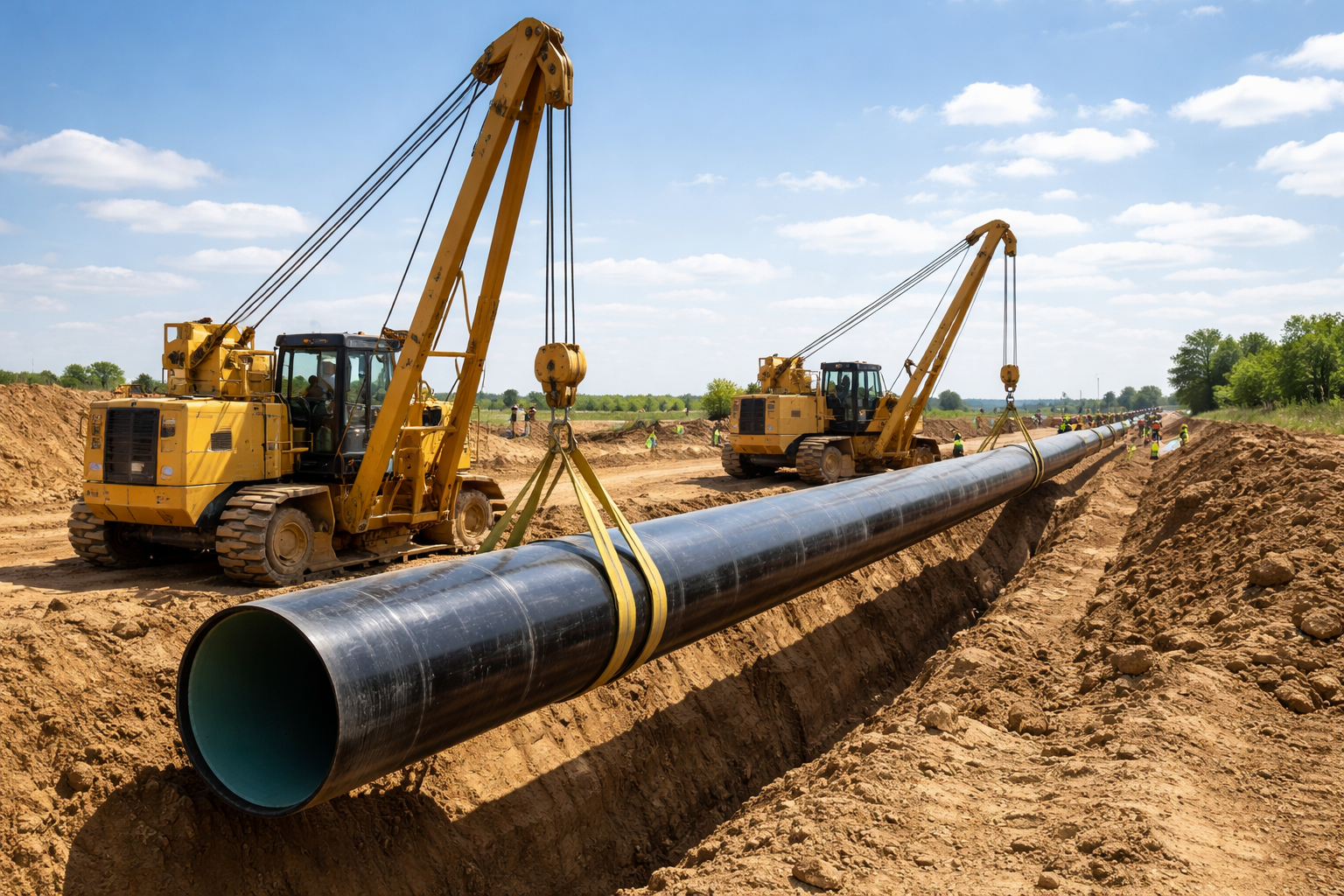
Pipe Lowering Analysis & Stress Calculator
Analyze pipe lowering into a trench with sidebooms using four modes: Fixed L checks a specified length, Find L range searches admissible lengths, Min. supports searches the smallest support count, and Find h searches admissible vertical end offsets.
L is the span along the x-axis between the fixed ends; hv and hl are the vertical and lateral offsets of the right end, with hv positive upwards. Add up to 20 equally spaced vertical supports that carry load only when in contact, and optionally enable rigid, horizontal, frictionless ground contact at the specified minimum pipe-axis elevation.
All four modes support free axial sliding (bending stress) or axial restraint (coupled axial tension and bending; combined normal stress governs), with or without ground contact. Searches with ground or axial restraint are exploratory: coverage is not certified, and a support count above zero is not certified minimal. Review numerical validity and model limits alongside the stress verdict; physical validity is not assessed. Results and PDF reports are available in SI or imperial units.
Geometry
Analysis
Solve the pipe for the length L entered in Geometry.
Supports are equally spaced candidate vertical supports (unilateral contact). Fixed-end pipe; linear model in free sliding, von Karman axial coupling when restrained.
Material
Anti-corrosion Coating
Allowable Stress
Loading
Export report
Presets
Save the complete input set (geometry, material, coating, load and calculation mode) on this device, and reload it in one click. Presets can be exported to a file to move them to another device.